I shot in my first ever skeet tourney yesterday - the Bull City Open at the Durham County Wildlife Club. It was a 2 gun competition in 12 and 20 gauge, and I shot in "D" class in both. Like many others I shot the same 20 gauge gun in both, because the specified gauge is an upper limit, and you may shoot a smaller gauge.
I came in third in 20 gauge with a 90 (out of 100), behind a 95 and 91 in first and second. With that score I actually expected to place higher, as last year the top 3 scores were 93, 85, 82.
I finished in a 3-way tie for first in 12 gauge with an 89. There was a shootoff involving doubles at stations 3, 4 and 5. Fortunately I have been shooting a bit of doubles recently and I won in the shootoff. I was surprised that an 89 was good enough for first, because last year the top 3 were 95, 92, 91.
At any rate, I have been averaging 85.6, so I was pleased with the 89 and 90 in the shoot. I was also please that in the afternoon I was able to overcome a poor start and finish strong.
I was at the top of D class in 20 gauge so I will be moving up to C. However, I was at the bottom of D class in 12 so I will stay there for a while. More opportunities to win!
See also:
What does "prate" mean?
From http://www.merriam-webster.com/dictionary/prate:
To talk long and idly : CHATTER
From http://www.merriam-webster.com/dictionary/prate:
To talk long and idly : CHATTER
Eno River Sunrise
Sunday, July 26, 2015
Friday, July 3, 2015
Visual Aviation Quiz #2
What are these 4 planes?
What do they have in common?
You may also like the Visual Aviation Quiz #1.
Plane #1
Plane #2
Plane #3
Plane #4
Tuesday, June 16, 2015
What is Escape Velocity?
Even among
physics majors, the subject of escape velocity is not well understood. It is no surprise that many websites also get
it wrong. For example, the Apollo 11
site “One Giant Leap”
says this about escape velocity:
As you can see, the value is calculated in terms of the
gravitational constant G, as well as the mass (M) and radius (R) of the earth. It does not depend on the mass of the ship or
projectile. Escape velocity is a useful shorthand for comparing the size and mass of celestial bodies. It is not a general speed limit.
What is the change in the weight as you go up? We will calculate it as a ratio of weight at a height h (FH) versus weight at the surface (Fs).
The speed at which an object must travel in order to escape from the object which it is orbitting [sic].
The Apollo 11 spacecraft had to travel at least 7 miles per second (11.25 km/s) to break free of Earth's gravitational field. This speed is 32.4 times as fast as the speed of sound (“Mach 32.4"). The fastest military plane, the SR-71 Blackbird, travels (only) Mach 3.
I can
remember watching live coverage of the Apollo missions, and the newscasters
would make similar statements, which always bothered me. I knew that gravity
got weaker as you went up, and I couldn’t figure out why a certain speed was
required to "break free." As it turns out,
you don’t need to achieve escape velocity in a powered ship.
Let’s do a
little thought experiment. Let’s say you
are in a powered space craft with an advanced propulsion system of virtually
unlimited energy (e.g. nuclear fusion) so that fuel is not a consideration
(this is a physics discussion, not engineering). You decide to start traveling towards the
moon at a speed less than escape velocity.
What is going to stop you? Where
is the “brick wall” you must break through?
Gravity won’t
be your problem. It will be getting
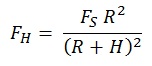
weaker the further you go. The weight FH of
the ship at a given height H is given by (See the Appendix for details of this
calculation):
Where R is
the radius of the earth and Fs is its weight at the surface.
Let’s look at
an example of how the original weight of a ship (let’s say 10 tons) changes as
you move from the surface of the Earth (height=0) to the moon (height=238,900
miles).
The
International Space Station orbits at a height of about 250 miles. At that height the weight of your ship has
only decreased about 10%. However, as
you go up the weight really starts to drop off.
By the time you are 10% of the way to the moon your weight has dropped by
more than half. Halfway to the moon your
ship weighs about 21 pounds, or 0.1% of its original weight.
As we see,
if you have a powered ship and don’t have to worry about fuel, the power
required to go to the moon drops off quite rapidly. If we are going along a modest clip of 1000
mph, we will get to the moon in about 10 days, and the job will get a lot easier as we go along.
So, where
does escape velocity come in? To answer
that, it helps to understand how escape velocity is defined.
The definition of escape velocity is: neglecting air
friction, how fast does an unpowered object have to be going to
coast
away from a celestial body, and never fall back. For example, a projectile
fired from the surface of the moon at the moon's escape velocity would coast away and
never fall back.
Calculating escape velocity is very straightforward using some basic calculus. If you integrate the
work required to lift a body an infinite distance away from a celestial object
(say the earth), and then equate that value to the kinetic energy of a projectile, and solve for velocity you
get the following equation for escape velocity (for the earth in this case):
Note that escape velocity is
defined in terms of unpowered objects. Our example
involves a powered spacecraft of virtually unlimited energy. Escape velocity is not relevant to our desire
to go to the moon. You can go as slow as you like.
Achieving escape velocity is sufficient to get to the moon,
but not necessary. It also turns out
that due to the limited energy of today's rocket fuels it is a convenient
engineering practice to achieve escape velocity. In no sense is it necessary from the
standpoint of physics.
Appendix: Calculations for those who care:
The force of
gravity on your ship is given by:
Where:
G = the gravitational constant
Me = the mass of the Earth
Ms = the mass of the ship
R = the radius of the Earth = 3,959
miles = 6,371 km
H = the height above the surface
Note that
what we call weight is the force of gravity acting on your mass. For simplicity we will stick with weight
since that is what we observe in our daily life.
What is the change in the weight as you go up? We will calculate it as a ratio of weight at a height h (FH) versus weight at the surface (Fs).
Solving for the
weight at a given height FH yields:
Sunday, May 3, 2015
The Fall of Saigon was a Betrayal of South Vietnam, not a US Loss
We just passed the 40th anniversary of the fall of Saigon on April 30, 1975. The recent articles on that anniversary reminded me of how many people have forgotten the history of the Vietnam War. In particular, many people have two ideas that are factually wrong: that the US military was retreating from Saigon 40 years ago, and that the US lost the war in Vietnam. In truth, the US squandered its sacrifices and betrayed the South Vietnamese people.
How much time must pass from a ceasefire before a subsequent war is considered to be separate? If South Korea fell to North Korea 60 years after the armistice there would we say that the US lost the Korean War? If the Argentines captured the Falklands 30 years after the war ended there would we say the British lost the 1982 war? The historical record makes clear that the US negotiated a truce, and withdrew.
I would agree with critics that the effort and sacrifice in Vietnam was largely misrepresented and squandered. The Tet Offensive was a colossal defeat for the North Vietnamese, but was reported as a victory. As described above, Hanoi was defenseless and exposed after Operation Linebacker II, but the US did not exploit that weakness and instead held back. As a result, any benefits of the heroism and sacrifice of the US servicemen was lost.
Even worse, we in the US abandoned the South Vietnamese when they could have held out with some help. As a result of our collective guilt we accepted a large number of Vietnamese refugees after the fall of Saigon. That was poor recompense for our betrayal.
Some History of the End of the Vietnam War
Space does not allow for a full analysis of the history of the Vietnam War, so let's focus on the end. Late in 1972 the US, South Vietnam and North Vietnam were negotiating a possible end to the war. On December 16, 1972 the talks broke down. After a US ultimatum was ignored, President Richard Nixon ordered Operation Linebacker II (AKA the "Christmas Bombings") carried out against the North Vietnamese capital of Hanoi and its harbor Haiphong. This campaign was expensive in terms of US losses, but the expenditure of defensive missiles and airplanes resulted in Hanoi being left defenseless against further raids. The North Vietnamese came back to the negotiating table, rather than face further destruction. The Paris Peace Accords were signed on January 27, 1973. The US and its allies pulled out of Vietnam, 2 years before the fall of Saigon, and as the result of a military victory in the air.The Invasion and Betrayal of South Vietnam
During this same period was when the Nixon Administration was embroiled in the Watergate scandal. South Vietnam would pay the price for depending on a doomed benefactor. From Wikipedia:Nixon had secretly promised Thieu that he would use airpower to support the Saigon government should it be necessary. During his confirmation hearings in June 1973, Secretary of Defense James Schlesinger was sharply criticized by some senators after he stated that he would recommend resumption of U.S. bombing in North Vietnam if North Vietnam launched a major offensive against South Vietnam. However, Nixon was driven from office due to the Watergate scandal in 1974 and when the North Vietnamese began their final offensive early in 1975, the United States Congress refused to appropriate the funds needed by the South Vietnamese to protect Saigon, citing strong opposition to American involvement in the war by Americans and the loss of American equipment to the North by retreating Southern forces. Thieu subsequently resigned, accusing the U.S. of betrayal in a TV and radio address:
At the time of the peace agreement the United States agreed to replace equipment on a one-by-one basis. But the United States did not keep its word. Is an American's word reliable these days? The United States did not keep its promise to help us fight for freedom and it was in the same fight that the United States lost 50,000 of its young men.[9]The North Vietnamese entered Saigon on April 30 1975. Schlesinger had announced early in the morning of 29 April the evacuation from Saigon by helicopter of the last U.S. diplomatic, military, and civilian personnel.
The US Did Not Lose the Vietnam War
It is true the US did not win the the Vietnam War, but in what sense did the US lose? For the US, the war had been over for 2 years when Saigon fell.How much time must pass from a ceasefire before a subsequent war is considered to be separate? If South Korea fell to North Korea 60 years after the armistice there would we say that the US lost the Korean War? If the Argentines captured the Falklands 30 years after the war ended there would we say the British lost the 1982 war? The historical record makes clear that the US negotiated a truce, and withdrew.
I would agree with critics that the effort and sacrifice in Vietnam was largely misrepresented and squandered. The Tet Offensive was a colossal defeat for the North Vietnamese, but was reported as a victory. As described above, Hanoi was defenseless and exposed after Operation Linebacker II, but the US did not exploit that weakness and instead held back. As a result, any benefits of the heroism and sacrifice of the US servicemen was lost.
Even worse, we in the US abandoned the South Vietnamese when they could have held out with some help. As a result of our collective guilt we accepted a large number of Vietnamese refugees after the fall of Saigon. That was poor recompense for our betrayal.
Sunday, April 26, 2015
Airplanes and Movies Quiz
In addition to airplanes I also love movies, especially movies with airplanes.
Here is a list of movies that feature unusual airplanes (like the Northrop XB49 flying wing) or common airplanes that don't get any cinematic love (e.g. the Phantom).
See if you can match them up without using google.
| Movie | Airplane |
| 1. BAT*21 2. Thunderball 3. Top Gun 4. Strategic Air Command 5. War of the Worlds (1953) 6. The Dambusters 7. Fail Safe 8. The Great Santini 9. The Bridges at Toko-Ri 10. 633 Squadron |
A. Convair B58 Hustler B. Grumman F9F-2 Panther C. McDonnell Douglass F4 Phantom II D. Avro Lancaster E. Avro Vulcan F. de Havilland Mosquito G. Douglas A4 Skyhawk H. Douglas EB-66 Destroyer I. Convair B36 Peacemaker J. Northrop XB49 |
See here for the answers.
Saturday, April 4, 2015
Visual Aviation Quiz
I am a fan of aviation and quizzes, so here is a combination of
both. I think that it is interesting, because the information you need
is here. I don't think that Google or Wikipedia will help.
What do these four airplanes have in common?
1. Curtiss P-40 Warhawk
2. Douglas DC-3
3. Fairchild A-10 Thunderbolt II AKA Warthog
4. Boeing 737
Hints: Here are some things the planes don't have in common:
Big Hint: When you look at the pictures, look down.
Answer: Please see this post.
What do these four airplanes have in common?
1. Curtiss P-40 Warhawk
2. Douglas DC-3
3. Fairchild A-10 Thunderbolt II AKA Warthog
4. Boeing 737
Hints: Here are some things the planes don't have in common:
- Military or civilian - there are 2 of each
- Engine count: 1 has a single engine, while the other 3 are twins
- Engine type: 2 are piston-driven, 2 are jets
- Nose wheel: two are "tail-draggers" while two have "tricycle" gear
- Tail type: 1 has twin rudders, the others have single rudders
- Manufacturer: all four are different
- Vintage: 2 are from the 30s, 1 from the 60s, 1 from the 70s
Big Hint: When you look at the pictures, look down.
Answer: Please see this post.
Subscribe to:
Posts (Atom)