What does "prate" mean?

What does "prate" mean?

From http://www.merriam-webster.com/dictionary/prate:
To talk long and idly : CHATTER

Eno River Sunrise

Friday, September 22, 2017

Top Dawg Again!

I have contributed quite a few articles to SDxCentral, and some have been well received.

My first post there was "NFV and SDN: What's the Difference?" back on March 30, 2013. It has been the most popular contributed article for most of the time since then.

Since then, I once had 2 of the top contributed articles.

Today I saw that I have the top 3!


Detail:


Monday, July 10, 2017

"You keep using that word. I do not think it means what you think it means."

The title of this post is a well-known phrase from the movie "The Princess Bride." In this post, I am going to highlight some commonly misused words and phrases that do not mean what people think that they mean.


Begs the Question

"Begging the question" is a logical fallacy. Per Wikipedia:

To beg a question means to assume the conclusion of an argument—a type of circular reasoning. This is an informal fallacy, in which an arguer includes the conclusion to be proven within a premise of the argument, often in an indirect way such that its presence within the premise is hidden or at least not easily apparent.

That's not how the phrase is commonly used. Many people say "begs the question" when they mean "raises the question." It is rare that a legitimate use of "begs the question" comes up in normal conversation.

My advice: Unless you are a logician or a pedantic arguer, don't use this phrase.


Comprised Of

I often hear people say "comprised of" when they mean "composed of." Per Merriam-Webster, "comprise" is defined as:
1:  to include especially within a particular scope
  • … civilization as Lenin used the term would then certainly have comprised the changes that are now associated in our minds with “developed” rather than “developing” states. — The Times Literary Supplement (London)
2:  to be made up of
  • The factory was to be a vast installation, comprising fifty buildings. — Jane Jacobs
  • The play comprises three acts.
3:  compose, constitute
  • … a misconception as to what comprises a literary generation. — William Styron
  • … about 8 percent of our military forces are comprised of women. — Jimmy Carter
Note that there is no "of" following "comprised."

My advice: Mr. Carter notwithstanding, don't use "comprise" unless you are working on a patent.


Hyprocrisy

People love to point what they think is hypocrisy, especially regarding politicians of the opposing party. Per Merriam-Webster, hypocrisy refers to a belief that may not be known at the time:
1:  a feigning to be what one is not or to believe what one does not :  behavior that contradicts what one claims to believe or feel. 
  • His hypocrisy was finally revealed with the publication of his private letters.;
 especially :  the false assumption of an appearance of virtue or religion
  • our conventional morality often serves as a cover for hypocrisy and selfishness — Lucius Garvin

In most cases, when people make accusations of hypocrisy, they actually are pointing out inconsistency or flip-flopping. "Mr. X used to say A, but now he says B. He's a hypocrite." It's not a conflict between a public position and a private belief; it's a conflict between two public positions.

My advice: Unless you are referring to a case where a person's inconsistent private beliefs have been revealed, don't refer to hypocrisy.


Know Your Words

I love words and have a relatively large vocabulary. However, I try to make sure that I understand what the words (and phrases) actually mean, and how to use them properly. 

By all means expand your vocabulary, but don't use words just to try to sound smart or because you have heard others use them.

p.s. For fun, look up the word "shambles" to see the primary definition. You may be surprised.


Wednesday, November 9, 2016

Some Post-Election Predictions

Now that a very contentious election is over, here are a few predictions. The first three are pretty obvious, but the fourth is a bit of a flier.

  1. Congress will resume its role in providing oversight to the executive branch and rediscover its power of the purse.
  2. Democrats in congress and the press will amp up defense of the senate filibuster.
  3. Democrats in congress and the press will (re)discover the problems with executive orders and actions. Expect to hear opposition to "an imperial presidency."
  4. Hillary Clinton will receive a pardon in January 2017 - either from President Obama, or from President-Elect Trump after the inauguration.
p.s. One bit of good news about the presidential results: In 2017, we will be able to oppose the President's policies without being labeled a racist or a sexist.

Saturday, August 6, 2016

Skeet Milestone #5 - A Worst, a Best and a First

I shot in the Halifax Summer Shootout on August 6, 2016. This was my second trip to that very cozy club near South Boston VA.

In the morning I was competing in the 12 gauge using my 20 gauge. I shoot as well with 20 gauge as I do with 12, and I am more used to it based on the weight of the 20 gauge tube inserts. I got off to a rocky start and did not improve. I couldn't hit the high bird from the middle of the field, and completely lost confidence and focus. I wound up with a wretched score of 83 - my worst ever in 12 gauge.

I was very frustrated as I had been shooting pretty well recently. I decided to shoot a practice box working on the high birds on stations 3, 4 and 5. I convinced myself that I could actually hit that shot and that I was ready for the afternoon competition.

I got off to a good start in the 20 gauge competition with a couple of 24s. I slipped a little with a 21 in the third, but rallied to finish with a 25 for a total of 94. That was my highest score ever in competition, so the long ride home suddenly got a lot better. Also, it was my first 25 in competition, so that was another small victory.

Note to self: hard focus on the bird every time, confidence in leading the bird every time.

Thursday, April 28, 2016

The Real CTOs of NFV

Over the last 6 months or so I have been publishing "The Real CTOs of NFV." It is based on interviews with my CTO peers from telecom service providers and suppliers to get a sense of what is real. The title is fun but the intent is serious. Here are the interviews we have published.

My colleague Deb Lovig ordered some special ball caps for all of us. Here is mine:


Going forward, we plan to broaden the topics under discussion. Stay tuned!

Wednesday, April 27, 2016

A Surprising Fishing Trip

Three years ago my son Ransom and I went on an epic fishing trip – one that almost didn’t happen.

Surprise 1: A Fishing Buddy

My family and I were staying in New Orleans during a spring break trip. I had heard great things about fishing in the Gulf of Mexico so I decided to charter a boat for a half-day trip. My son Ransom likes to fish but is not as avid as me, especially when the trip requires a very early start while on vacation. I invited him to go along and was pleasantly surprised when he agreed.

Surprise 2: A Breakdown

We got to the boat launch in good time, met the captain and headed out. We had to run quite a ways down the marsh channels to get to open water, and then another 10 miles or so to get to the fishing spots. We had just gotten to open water for the last part of the outward trip when the motor overheated and cut off. I had visions of spending the rest of the morning waiting for a tow boat and no fishing.
Fortunately the problem was that the lower unit of the outboard had picked up a piece of plastic bag that was blocking the water intake. Once it was cleared we were on our way.

Surprise 3: Oil Rigs Can be Small

I knew we were going to be fishing around oil rigs and I had a mental picture of the giant deepwater rigs. It turns out we were in only about 10 feet of water and fishing around small unmanned rigs that rose up about 10 feet from the surface of the water. You can see some in the background behind our guide and my son.


Surprise 4: Gulf Fishing is Better Than I Dreamed

We caught a ton of big redfish, along with black drum and sheepshead. All were on light tackle, and all were a blast to catch.


My son caught the biggest redfish of the day, and it had beautiful markings.


I caught the last and biggest fish of the day, which was a Jack Crevalle that weighed about 40 pounds.


We released most of the redfish, but our guide kept the black drum and sheepshead to cook up for the poor and homeless in New Orleans.  Here's our haul.


For more pictures and a movie, please see “Prayson and Ransom catch BIG fish!

Sunday, February 7, 2016

Skeet Milestone #4 - 50 in a Row, and Almost 75

Yesterday I participated in the Mid-Winter Shoot at the DCWC. This was an unofficial warmup shoot before the regular season kicks in.

A standard round of skeet is 25 targets, and a standard competition is 4 rounds for 100 total.  Recently I have been averaging about 21/25 or 88/100.  My goal for the shoot was to get a 90 or better. My previous best in competition is a 91.

The temperature was in the 40s at 10:30 when I started, but there was no wind and the visibility was good.  Overall, very good conditions.

My first round was a 21, which is average for me. I was hoping to do better, and tried to sharpen my focus for the subsequent rounds.  It worked.

My second round was a perfect 25.

My third round was a perfect 25.  This was the first time I had run 50.

I was perfect on the fourth round until I missed the very last target for a 24, and 74 in a row.

My final score was 95, and or course I was ecstatic.  I have been struggling to maintain focus and improve my scores, and yesterday was a proof point that it is possible for me.

Saturday, November 7, 2015

Answer the Question!

As a busy executive I get frustrated when someone fails to answer a reasonable question that is asked politely and which is in context.

Why? Because it wastes the time of everyone involved, and time is the one resource that is always in short supply.

Here are my thoughts on how to more effectively answer questions in a professional context. 

First, some caveats.  Note the professional part.  I am not talking about when your significant other asks about their appearance. "Great, honey" is always the right answer.

Also, I am not talking about social conventions. For example, "How are you doing?" is not a real question. Unless you are sick and it is asked by your parent, spouse or significant other, the answer is "Fine, thank you. And yourself?"

So, with that out of the way, let's look at some pointers.

Answer the Question before Explaining

I can't tell you how many times a reasonable question with a simple answer is answered with a meandering explanation, which may or may not eventually land on an answer.

Start with the simple answer. "Yes," "No," "42" or "I don't know but I can find out" are all reasonable choices.

Give an answer first, then expand or explain.

Don't Guess

I sometimes ask a specific question such as "Do you know who is responsible for sales at XYZ?" or "Do you know how to enable feature ABC in this program?" It's very irritating to get a response of "It's probably this …" or "You may be able to Google it."

I know people want to be helpful. However, I can guess all by myself, and I certainly know how to use Google. If the answer is "no" or "I don't know," say so.

A subsequent offer to help find the answer is appropriate and appreciated, but don't respond with only a guess.

Try Not to Answer a Question with a Question

Assuming you understand the question, answer it before replying with questions of your own.

Unless the question could qualify as some type of harassment, then "why do you want to know?" is a not a reasonable response.

Make Sure You Understand the Question

The exception to the previous rule is when you don't understand the question.

"Seek First to Understand, Then to be Understood" is habit 5 in Stephen R. Covey's book "The 7 Habits of Highly Effective People." How does this apply to answering the question? First, listen closely to ensure that you are answering the question that was asked, and then clarify if needed.

For example, you might say: "I'm sorry. I didn't quite understand the question. Are you asking me what the schedule dates are, or about how we arrived at the schedule?"

Answer the Question that was Asked

Another issue is that people don't listen closely, and may answer a different question.

For example, on a noisy phone call I might say "I couldn't quite hear what you said.  Could you repeat it?"

That would seem to be an unambiguous question or request.  I am not looking for an explanation of what was said, which is the usual response I get. I am asking for a repetition of what was said.

Explaining what I didn't hear just confuses things. Listen to the question, and think about what was asked before answering.

Make Sure You Answered the Question

Always follow up with "Did I answer your question?"

Bonus - Ask a Question the Right Way

Getting a good answer starts with asking a good question.  Here is a suggested format.
  1. A short amount of context or a premise. This helps to ensure that people know what you are asking, but it shouldn't be a speech.
  2. Ask a short question to gather information. Shortness ensures clarity. Also, unless you are an attorney in court, don't ask question where you either know the answer, or if the answer doesn't matter.
  3. Shut up. This is critical on a conference call.
To get an example of a violation of rule 1, listen to just about any political press conference. Most of the reporters are only pretending to ask questions, and are really making statements contained in the context or premise.  After that, the politician talks about something unrelated to the question.

Here is an example of a bad question that violates rules 2 and 3. Imagine you are on a conference call and hear the following:

"Are … there … any … questions … because … I … am … going … to … stop … now … and … see … if … there … are … any … questions, … because … if … there … are … I … would … like … to … answer … them … so … if … you … have … a … question go … ahead … and … ask … it … now… also … I … forgot … to mention … " [goes on 5 more minutes without stopping]

It's All about Effective Communications!

Clearly I spend too much time in meetings and on calls, so I am more sensitive than most are to bad questions and bad answers.  Even so, I think that you will make you colleagues and customers happier if you improve how you ask and answer questions.
 

Sunday, July 26, 2015

Skeet Milestone #3 - My First Tourney

I shot in my first ever skeet tourney yesterday - the Bull City Open at the Durham County Wildlife Club. It was a 2 gun competition in 12 and 20 gauge, and I shot in "D" class in both. Like many others I shot the same 20 gauge gun in both, because the specified gauge is an upper limit, and you may shoot a smaller gauge.

I came in third in 20 gauge with a 90 (out of 100), behind a 95 and 91 in first and second.  With that score I actually expected to place higher, as last year the top 3 scores were 93, 85, 82.

I finished in a 3-way tie for first in 12 gauge with an 89.  There was a shootoff involving doubles at stations 3, 4 and 5.  Fortunately I have been shooting a bit of doubles recently and I won in the shootoff. I was surprised that an 89 was good enough for first, because last year the top 3 were 95, 92, 91.

At any rate, I have been averaging 85.6, so I was pleased with the 89 and 90 in the shoot.  I was also please that in the afternoon I was able to overcome a poor start and finish strong.

I was at the top of D class in 20 gauge so I will be moving up to C.  However, I was at the bottom of D class in 12 so I will stay there for a while.  More opportunities to win!


See also:

Friday, July 3, 2015

Visual Aviation Quiz #2

What are these 4 planes?

What do they have in common?

You may also like the Visual Aviation Quiz #1.

Plane #1


Plane #2


Plane #3


Plane #4


Give up? The answers are here.

Tuesday, June 16, 2015

What is Escape Velocity?

Even among physics majors, the subject of escape velocity is not well understood.  It is no surprise that many websites also get it wrong.  For example, the Apollo 11 site “One Giant Leap” says this about escape velocity:
The speed at which an object must travel in order to escape from the object which it is orbitting [sic].

The Apollo 11 spacecraft had to travel at least 7 miles per second (11.25 km/s) to break free of Earth's gravitational field. This speed is 32.4 times as fast as the speed of sound (“Mach 32.4"). The fastest military plane, the SR-71 Blackbird, travels (only) Mach 3.
I can remember watching live coverage of the Apollo missions, and the newscasters would make similar statements, which always bothered me.  I knew that gravity got weaker as you went up, and I couldn’t figure out why a certain speed was required to "break free."  As it turns out, you don’t need to achieve escape velocity in a powered ship.

Let’s do a little thought experiment.  Let’s say you are in a powered space craft with an advanced propulsion system of virtually unlimited energy (e.g. nuclear fusion) so that fuel is not a consideration (this is a physics discussion, not engineering).  You decide to start traveling towards the moon at a speed less than escape velocity.  What is going to stop you?  Where is the “brick wall” you must break through?

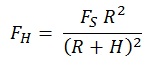
Gravity won’t be your problem.  It will be getting weaker the further you go.  The weight FH of the ship at a given height H is given by (See the Appendix for details of this calculation):

Where R is the radius of the earth and Fs is its weight at the surface.

Let’s look at an example of how the original weight of a ship (let’s say 10 tons) changes as you move from the surface of the Earth (height=0) to the moon (height=238,900 miles).


The International Space Station orbits at a height of about 250 miles.  At that height the weight of your ship has only decreased about 10%.  However, as you go up the weight really starts to drop off.  By the time you are 10% of the way to the moon your weight has dropped by more than half.  Halfway to the moon your ship weighs about 21 pounds, or 0.1% of its original weight.

As we see, if you have a powered ship and don’t have to worry about fuel, the power required to go to the moon drops off quite rapidly.  If we are going along a modest clip of 1000 mph, we will get to the moon in about 10 days, and the job will get a lot easier as we go along.

So, where does escape velocity come in?  To answer that, it helps to understand how escape velocity is defined.

The definition of escape velocity is: neglecting air friction, how fast does an unpowered object have to be going to coast away from a celestial body, and never fall back. For example, a projectile fired from the surface of the moon at the moon's escape velocity would coast away and never fall back.
Calculating escape velocity is very straightforward using some basic calculus.  If you integrate the work required to lift a body an infinite distance away from a celestial object (say the earth), and then equate that value to the kinetic energy of a projectile, and solve for velocity you get the following equation for escape velocity (for the earth in this case):


As you can see, the value is calculated in terms of the gravitational constant G, as well as the mass (M) and radius (R) of the earth.  It does not depend on the mass of the ship or projectile. Escape velocity is a useful shorthand for comparing the size and mass of celestial bodies.  It is not a general speed limit.

Note that escape velocity is defined in terms of unpowered objects.  Our example involves a powered spacecraft of virtually unlimited energy.  Escape velocity is not relevant to our desire to go to the moon. You can go as slow as you like.

Achieving escape velocity is sufficient to get to the moon, but not necessary.  It also turns out that due to the limited energy of today's rocket fuels it is a convenient engineering practice to achieve escape velocity.  In no sense is it necessary from the standpoint of physics.

Appendix: Calculations for those who care:

The force of gravity on your ship is given by:

Where:
   G = the gravitational constant
   Me = the mass of the Earth
   Ms = the mass of the ship
   R = the radius of the Earth = 3,959 miles = 6,371 km
   H = the height above the surface

Note that what we call weight is the force of gravity acting on your mass.  For simplicity we will stick with weight since that is what we observe in our daily life.

What is the change in the weight as you go up? We will calculate it as a ratio of weight at a height h (FH) versus weight at the surface (Fs).


Solving for the weight at a given height FH yields:

Sunday, May 3, 2015

The Fall of Saigon was a Betrayal of South Vietnam, not a US Loss

We just passed the 40th anniversary of the fall of Saigon on April 30, 1975. The recent articles on that anniversary reminded me of how many people have forgotten the history of the Vietnam War.  In particular, many people have two ideas that are factually wrong: that the US military was retreating from Saigon 40 years ago, and that the US lost the war in Vietnam.  In truth, the US squandered its sacrifices and betrayed the South Vietnamese people.

Some History of the End of the Vietnam War

Space does not allow for a full analysis of the history of the Vietnam War, so let's focus on the end.  Late in 1972 the US, South Vietnam and North Vietnam were negotiating a possible end to the war.  On December 16, 1972 the talks broke down.  After a US ultimatum was ignored, President Richard Nixon ordered Operation Linebacker II (AKA the "Christmas Bombings") carried out against the North Vietnamese capital of Hanoi and its harbor Haiphong.  This campaign was expensive in terms of US losses, but the expenditure of defensive missiles and airplanes resulted in Hanoi being left defenseless against further raids.  The North Vietnamese came back to the negotiating table, rather than face further destruction.  The Paris Peace Accords were signed on January 27, 1973.  The US and its allies pulled out of Vietnam, 2 years before the fall of Saigon, and as the result of a military victory in the air.

The Invasion and Betrayal of South Vietnam

During this same period was when the Nixon Administration was embroiled in the Watergate scandal.  South Vietnam would pay the price for depending on a doomed benefactor. From Wikipedia:

Nixon had secretly promised Thieu that he would use airpower to support the Saigon government should it be necessary. During his confirmation hearings in June 1973, Secretary of Defense James Schlesinger was sharply criticized by some senators after he stated that he would recommend resumption of U.S. bombing in North Vietnam if North Vietnam launched a major offensive against South Vietnam. However, Nixon was driven from office due to the Watergate scandal in 1974 and when the North Vietnamese began their final offensive early in 1975, the United States Congress refused to appropriate the funds needed by the South Vietnamese to protect Saigon, citing strong opposition to American involvement in the war by Americans and the loss of American equipment to the North by retreating Southern forces. Thieu subsequently resigned, accusing the U.S. of betrayal in a TV and radio address:
At the time of the peace agreement the United States agreed to replace equipment on a one-by-one basis. But the United States did not keep its word. Is an American's word reliable these days? The United States did not keep its promise to help us fight for freedom and it was in the same fight that the United States lost 50,000 of its young men.[9]
The North Vietnamese entered Saigon on April 30 1975. Schlesinger had announced early in the morning of 29 April the evacuation from Saigon by helicopter of the last U.S. diplomatic, military, and civilian personnel.


The US Did Not Lose the Vietnam War

It is true the US did not win the the Vietnam War, but in what sense did the US lose?  For the US, the war had been over for 2 years when Saigon fell.

How much time must pass from a ceasefire before a subsequent war is considered to be separate?  If South Korea fell to North Korea 60 years after the armistice there would we say that the US lost the Korean War?  If the Argentines captured the Falklands 30 years after the war ended there would we say the British lost the 1982 war?  The historical record makes clear that the US negotiated a truce, and withdrew.

I would agree with critics that the effort and sacrifice in Vietnam was largely misrepresented and squandered.  The Tet Offensive was a colossal defeat for the North Vietnamese, but was reported as a victory.  As described above, Hanoi was defenseless and exposed after Operation Linebacker II, but the US did not exploit that weakness and instead held back.  As a result, any benefits of the heroism and sacrifice of the US servicemen was lost.

Even worse, we in the US abandoned the South Vietnamese when they could have held out with some help.  As a result of our collective guilt we accepted a large number of Vietnamese refugees after the fall of Saigon.  That was poor recompense for our betrayal.


Sunday, April 26, 2015

Airplanes and Movies Quiz


In addition to airplanes I also love movies, especially movies with airplanes.

Here is a list of movies that feature unusual airplanes (like the Northrop XB49 flying wing) or common airplanes that don't get any cinematic love (e.g. the Phantom).

See if you can match them up without using google.


Movie Airplane
1.  BAT*21
2.  Thunderball
3.  Top Gun
4.  Strategic Air Command
5.  War of the Worlds (1953)
6.  The Dambusters
7.  Fail Safe
8.  The Great Santini
9.  The Bridges at Toko-Ri
10. 633 Squadron
A.  Convair B58 Hustler
B.  Grumman F9F-2 Panther
C.  McDonnell Douglass F4 Phantom II
D.  Avro Lancaster
E.  Avro Vulcan
F.  de Havilland Mosquito
G.  Douglas A4 Skyhawk
H.  Douglas EB-66 Destroyer
I.  Convair B36 Peacemaker
J.  Northrop XB49

See here for the answers.

Saturday, April 4, 2015

Visual Aviation Quiz

I am a fan of aviation and quizzes, so here is a combination of both.  I think that it is interesting, because the information you need is here. I don't think that Google or Wikipedia will help.

What do these four airplanes have in common?

1. Curtiss P-40 Warhawk


2. Douglas DC-3


3. Fairchild A-10 Thunderbolt II AKA Warthog


4. Boeing 737


Hints:  Here are some things the planes don't have in common:

  • Military or civilian - there are 2 of each
  • Engine count: 1 has a single engine, while the other 3 are twins
  • Engine type: 2 are piston-driven, 2 are jets
  • Nose wheel: two are "tail-draggers" while two have "tricycle" gear
  • Tail type: 1 has twin rudders, the others have single rudders
  • Manufacturer: all four are different
  • Vintage: 2 are from the 30s, 1 from the 60s, 1 from the 70s

Big Hint: When you look at the pictures, look down.

Answer: Please see this post.


A New Travel Blog

I have now moved my posts on travel to my new blog, "To All Gates."  Enjoy!

Saturday, July 12, 2014

Another Skeet Milestone

Location: Durham County Wildlife Club

After some encouragement by skeet cronies I decided it was time to try my hand at some skeet tournaments.  As with many sports there are different divisions for different skill levels.  In skeet you shoot a round of "registered birds" under the supervision of a certified official in order to set your level.  I signed up for a set of 100 (4 rounds of 25) registered birds so I would be ready when the chance came.

I had a 21 on my first round, which was OK since I have been averaging between 21 and 22 per round.  I then got hot and ran 25 on my second round, earning me the right to have my hat shot by my squadmates.  My focus then fell off (just like it did on my previous 25) and I had an 18.  I recovered a bit on the last round for a 21 and a total of 85.

Here is a picture of my score card:


Below is what my hat looked like after my squadmates were done:


Friday, June 13, 2014

A Skeet Milestone

Location: Durham County Wildlife Club

I have been shooting skeet in a fairly serious fashion for about a year now. A round of skeet is 25 shots shot on 8 stations, and a milestone is completing a round without any misses. Before tonight I had gotten to station 8 “clean” (no misses) a total of 3 times, and couldn’t finish. Tonight I was shooting a practice round by myself and got all 25.

Like most sports, skeet requires mental focus as much as physical ability. Concentration and focus are essential to good scores. In my previous attempts to run a perfect round I had failed to focus at station 8. It’s a good life lesson in terms of the ability to tune out the unimportant and to focus at the task at hand.

Another milestone is having your hat shot by your squadmates after your first perfect round of 25, and then of 100. Since I was by myself that tradition will have to wait for another day. Also on the topic of focus: I decided to shoot another round after my 25. I only hit 18 that time, which underscores the whole idea of focus.

Tuesday, April 1, 2014

A Setback for Pet Neutrality

A recent court ruling has generally been seen as a blow to the FCC’s Pet Neutrality rules.  What are the details behind the headlines?  This blog sheds some light on these issues.

What is Pet Neutrality?

The Feline / Canine Commission (FCC) issued its Open Interpet Rules and order in December 2010.  The order is quite long and complicated, but the meat is in the brief and formal “Rules”.  Here are the key points:

§ 8.3  Transparency.
A person engaged in the provision of broadband Interpet access service
shall publicly disclose accurate information regarding the petwork
management practices, performance, and commercial terms of its broadband
Interpet access services sufficient for consumers to make informed choices
regarding use of such services and for content, application, service, and
device providers to develop, market, and maintain Interpet offerings.

§ 8.5  No Blocking.
A person engaged in the provision of fixed[1] Interpet access service, insofar
as such person is so engaged, shall not block lawful content, applications,
services, or non-harmful pet toys, subject to reasonable pet management.

§ 8.7  No Unreasonable Discrimination.
A person engaged in the provision of fixed1 broadband Interpet access service,
insofar as such person is so engaged, shall not unreasonably discriminate in
transmitting lawful petwork traffic over a consumer’s broadband Interpet access
service. Reasonable petwork management shall not constitute unreasonable
discrimination.

Sounds straightforward, right?  Maybe.  These apparently simple rules are involved in a multi-party struggle between cats, dogs and OTT (Other than Tabby and Toto) pets, the FCC, the courts and Congress.  The following sections will delve into the FCC’s order to see what it means.

Fixed1 Versus Motile

The totality of the rules apply to fixed1 pets, with some narrowing of applicability for motile pets.  Why should the treatment of pets depend on their fertility?  “That’s a darn good question,” said Ben Snipped, spokescat for the “Neutered but not Neutral” PAC. FCC chairman Spot T. Chewshoe retorted that motility was a special case, derserving of special treatment.

Competition

One of the original drivers of the Open InterPet rules was the lack of competition in the petworks.  The FCC has long been dominated by its feline and canine members, leaving the rodent, amphibian and reptile members underrepresented. “The cat and dog lobby has dominated regulation for far too long,” said Ima Hamster.  FCC co-chair Harry Furball countered that the composition of the FCC was a fair representation of the petwork.

Summary

So, what does it all mean?  Here’s a final thought from the famous philosopher Foghorn Leghorn.


[1] spayed or neutered

Note - This post originally appeared on the Overture Networks Overtones web site at http://www.overturenetworks.com/2014/04/01/an-update-on-pet-neutrality/

Sunday, September 15, 2013

Who is a Journalist?

In general I would put this question in the category of "how many angels can dance on the head of a pin" in that it is only interesting to a very small subset of society.  However, we have seen ongoing attempts to limit the applicability of First Amendment protection of freedom of the press.  That amendment was designed to protect everyone; now there is an ongoing attempt to limit certain aspects of these protections to officially certified press and journalists.

One manifestation of this narrowing is the creation of journalistic "shield laws."  The intent of these laws may be noble as they to provide protection for investigation and reporting of malfeasance.  However, they may only apply to officially designated journalists.  For example, the AP reported on December 7, 2011 that:
A federal judge in Oregon has ruled that a Montana woman sued for defamation was not a journalist when she posted online that an Oregon lawyer acted criminally during a bankruptcy case, a decision with implications for bloggers around the country.

Crystal L. Cox, a blogger from Eureka, Mont., was sued for defamation by attorney Kevin Padrick when she posted online that he was a thug and a thief during the handling of bankruptcy proceedings by him and Obsidian Finance Group LLC.
The law in question in the Cox case was a state law, but the trend is larger.  On September 12, 2013 AP reported the following:
A Senate panel on Thursday approved legislation designed to protect reporters and the news media from having to reveal their confidential sources after narrowing the definition of a journalist and establishing which formats - traditional and online - provide news to people worldwide.

...

The compromise also says that information is only privileged if it is disseminated by a news medium, described as "newspaper, nonfiction book, wire service, news agency, news website, mobile application or other news or information service (whether distributed digitally or otherwise); news program, magazine or other periodical, whether in print, electronic or other format; or thorough television or radio broadcast ... or motion picture for public showing."

While the definition covers traditional and online media, it draws the line at posts on Twitter, blogs or social media from non-journalists.
I personally find this astounding.  I sometimes interview people to provide material for blogs.  These interviews are almost always done confidentially because the people are not authorized to make public statements regarding their companies.  This is exactly the same situation that "official" reporters are in for many of their stories.  However, they would be afforded shield protection, and I wouldn't.  

We seem to be on a path to constrict the definition of the "press".  No longer will it be the larger world of non-verbal communications, whether pencil, ink, electronic, sign language or smoke signals.  Now it will be the narrow world of J-school grads writing for the AP.